Jan. 1, 1970
Filed from the West Wing · Wire #06
NEPA takes effect.
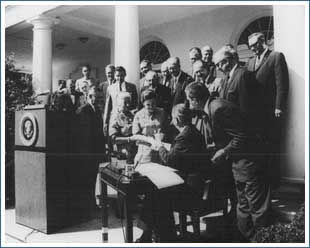
On New Year's Day, President Nixon signs the National Environmental Policy Act of 1969 (NEPA) — declaring it, in his words, "the most important piece of legislation in our history" up to that point. NEPA establishes a national environmental policy, creates the Council on Environmental Quality in the Executive Office of the President, and requires federal agencies to prepare an Environmental Impact Statement for every major action significantly affecting the environment.3
For the first time, the federal government is legally required to consider environmental consequences before approving highways, dams, military bases, pipelines, or any other federal project.
The National Environmental Policy Act · Section 101
Public Law 91-190 · 42 U.S.C. §4321 et seq. · Signed Jan. 1, 1970
"The Congress, recognizing the profound impact of man's activity on the interrelations of all components of the natural environment … declares that it is the continuing policy of the Federal Government, in cooperation with State and local governments, and other concerned public and private organizations, to use all practicable means and measures … to create and maintain conditions under which man and nature can exist in productive harmony, and fulfill the social, economic, and other requirements of present and future generations of Americans."
"The Congress recognizes that each person should enjoy a healthful environment and that each person has a responsibility to contribute to the preservation and enhancement of the environment."
Why this matters. NEPA is the legal expression of the ecological worldview that Rachel Carson and Aldo Leopold had pressed into American thought. Its first sentence acknowledges "the interrelations of all components of the natural environment" — the central insight of the science of ecology. Its key innovation, the Environmental Impact Statement, gave citizens and courts a powerful tool to force government agencies to disclose what their projects would do to air, water, wildlife, and historic landscapes. Within a decade, NEPA lawsuits had stopped or modified hundreds of federal projects. Its language about "present and future generations" echoes the Wilderness Act of 1964, but NEPA extended that principle to every federal action, not just land-use decisions. More than fifty years on, NEPA remains the most-cited environmental law in U.S. courts.